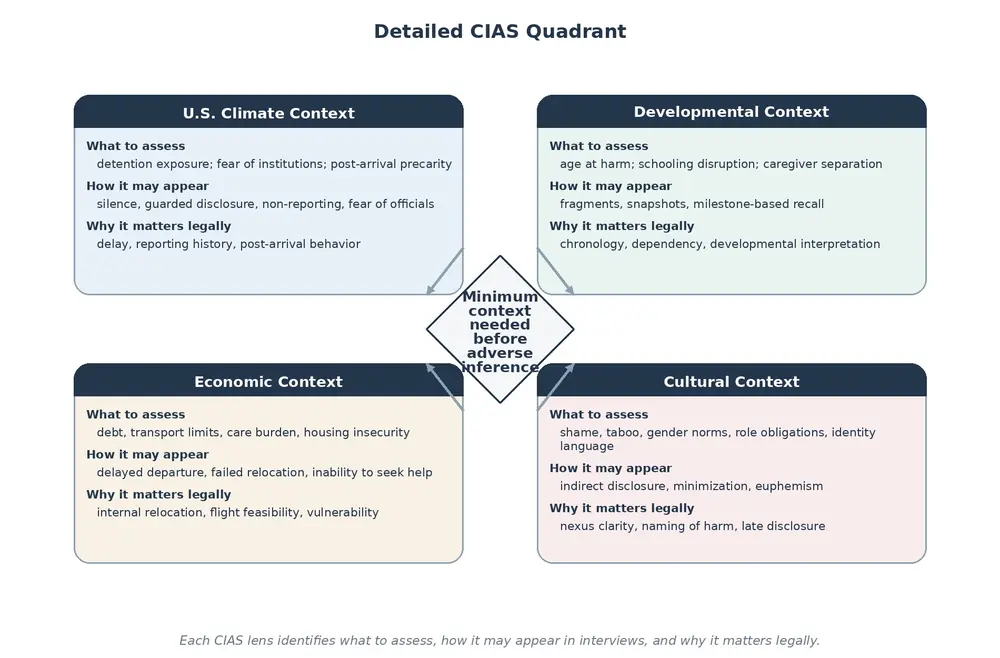
The CIAS framework in immigration practice.
CIAS is a peer-reviewed conceptual framework (Bekteshi & Kang, Ethnicity & Health, 2020). It helps explain how trauma, culture, developmental history, economic constraints, and U.S. climate shape adaptation, disclosure, memory, and help-seeking.
The CIAS Practitioner Toolkit is a separate practice aid that applies the framework to asylum casework.
A disciplined way to document context.
U.S. Climate
Legal precarity, institutional distrust, and disclosure shaped by immigration systems.
Cultural
Norms, shame, identity, family expectations, and gendered constraints.
Developmental
Age, memory, schooling disruption, trauma at different life stages.
Economic
Mobility, dependency, survival constraints, and feasibility of options.
How the four domains inform an evaluation
In an evaluation, the four domains shape what I ask about and what the report explains. Rather than treating a late disclosure, a gap in a timeline, or a change in wording as a sign of dishonesty, I document the U.S. climate, cultural, developmental, and economic context in which the person's account took shape, so the decision-maker can weigh it in that context.
A fictional example
This example is invented for illustration. It does not describe a real person or case.
"Lena," 34, did not mention a sexual assault in her first asylum interview and raised it only months later. An evaluation using the four domains would look at the shame and family expectations around speaking of it (cultural), her fear of authorities after the way police treated her at home (U.S. climate), her age when earlier harm began and how she anchors memories to life events rather than dates (developmental), and her financial dependence on the person who controlled her travel (economic). The report would describe how each of these shaped when and how she could disclose.
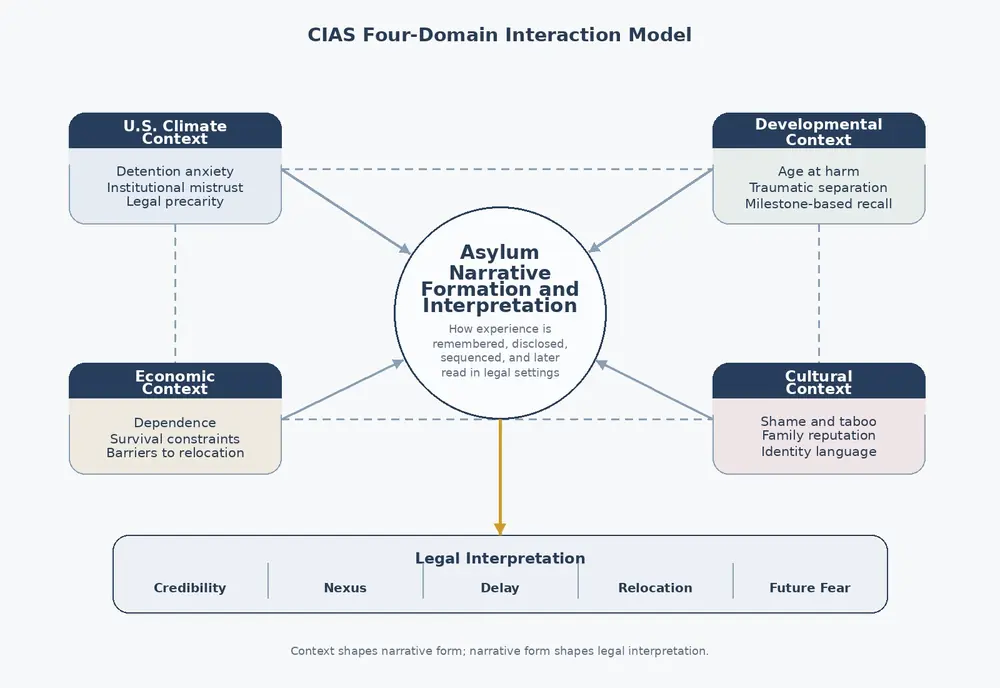
Four-domain model
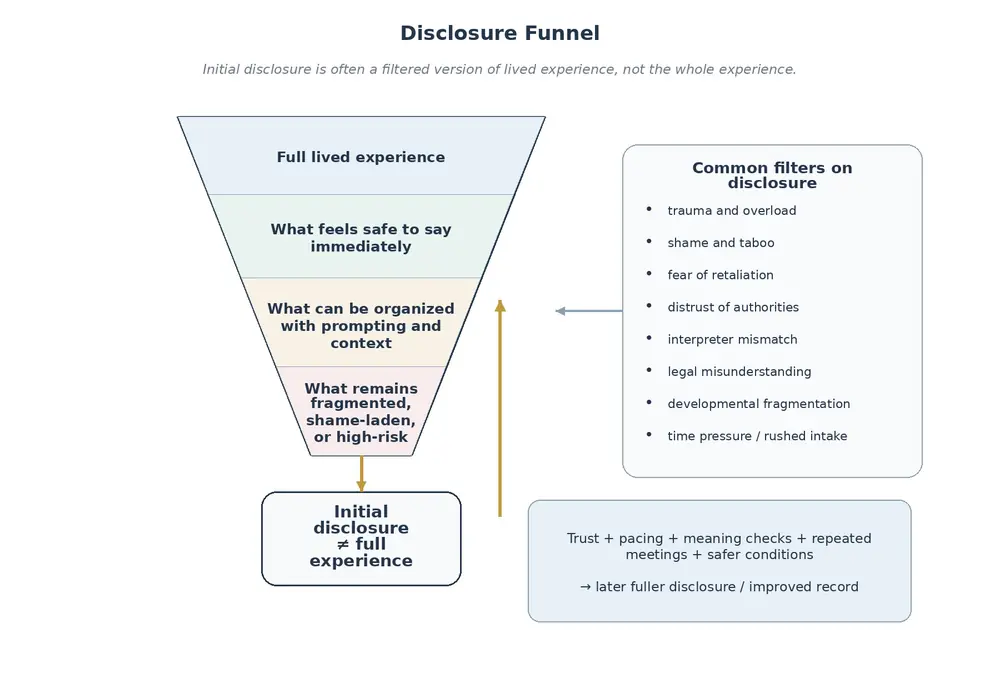
Disclosure funnel