A practical toolkit for credibility-sensitive immigration interviewing.
The CIAS Practitioner Toolkit is a structured practice aid for attorneys, accredited representatives, social workers, and interdisciplinary teams working on asylum and related immigration matters.
A practice aid, not a court form
The toolkit helps practitioners improve interviewing, documentation, narrative development, and credibility-sensitive analysis by capturing context early and responsibly. It is meant to support workflow, not replace legal judgment.
Published foundation
The toolkit is a separate practice aid. It grows from CIAS, a peer-reviewed conceptual framework (Bekteshi & Kang, Ethnicity & Health, 2020), and extends that framework into asylum-practice workflow.
CIAS frameworkWhat the toolkit includes
Intake triage
Issue spotting, viability flags, and “not ready yet” markers.
Case roadmap
A flexible narrative development roadmap, with compressed pathways for time-limited representation.
Prompt bank
Stage-specific questions that avoid forcing exact dates too early.
Disclosure framework
Neutral language for delay, partial disclosure, and barriers.
Declaration review
Core versus peripheral discrepancy analysis before filing.
Interpreter & evidence tools
Language-access logs, meaning checks, and exhibit planning.
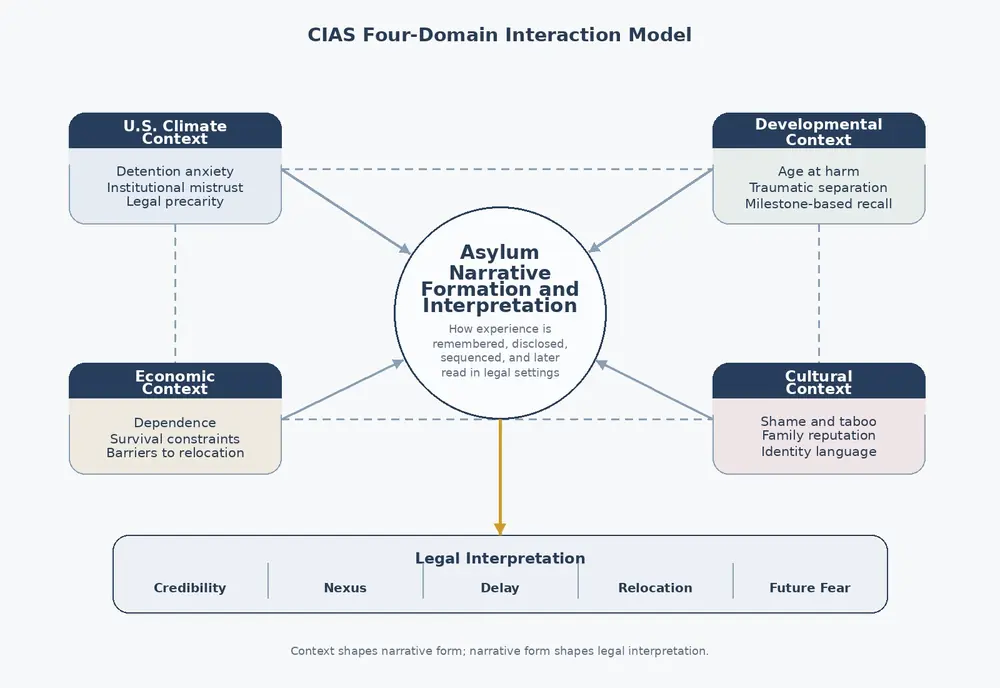
CIAS four-domain model
U.S. climate, cultural, developmental, and economic context shape disclosure and interpretation.
Use the summary first, then the full toolkit.
- Start with intake triage when the case is still forming.
- Use prompt banks when chronology or disclosure is difficult.
- Use declaration review before filing or finalizing a statement.
- Use interpreter guidance when meaning may be distorted.
- Use science briefs only when they address a specific weakness in the record.
CIAS training videos
Short trainings on the CIAS framework and its context lenses. Each one links to the matching section of the toolkit, has captions, and has a transcript below it.
CIAS Framework: Widen the Frame
Why CIAS looks at U.S. climate, cultural, developmental, and economic context before treating delay, silence, or inconsistency as a credibility problem.
1:52 · In the toolkit: Section 1. The CIAS Framework: Context Before Adverse Inference (p. 4) ↗
Read the transcript
A legal record asks for a clean timeline. A human life rarely arrives that way.
Imagine a hypothetical asylum seeker who initially says that an assault happened in the spring. Later, she remembers that it occurred after her family moved, placing it in the summer. The changed detail matters, but before deciding what it means, CIAS asks us to widen the frame.
CIAS stands for Contextual Influence in Acculturative Stress. It brings four intersecting contexts into view. The U.S. climate includes legal precarity, fear of detention, and mistrust of institutions. The developmental context considers the person's age at the time of harm, separation, and developmental stage. The economic context includes survival work, dependence, unstable housing, and barriers to seeking help. And the cultural context considers shame, family reputation, disclosure norms, and the language available for painful experiences.
No single lens explains why a detail changed. CIAS is not a credibility test. It does not prove that trauma caused an inconsistency, and it cannot determine whether an account is true. It helps us ask a more disciplined question: What conditions shaped the form in which this story became tellable? Because experience does not enter a legal record untouched. It is remembered, translated, disclosed, sequenced, and interpreted.
Before interpreting the record, widen the frame.
In the next videos, I'll open each CIAS domain and explore how it can be used, and where its limits must be respected. You can find the toolkit at forwardwithdignity.org/toolkit.html.
Economic Context
Whether relocation, escape, transport, reporting, or help-seeking was actually feasible, and how practical barriers bear on internal relocation, dependence, and vulnerability.
1:35 · In the toolkit: Section 1, Table 1: Economic context (p. 6) ↗
Read: An hour of help. A day of wages. · The money is there. The choice may not be.
Read the transcript
Sometimes, the distance between danger and safety is measured in bus fare.
I'm Dr. Venera Bekteshi. Today, we're exploring the economic context domain of the CIAS Toolkit, which you can find in forwardwithdignity.org.
This domain asks: Was relocation or seeking help actually feasible? We must look at the practicalities: money, transportation, housing, work, caregiving, and dependence.
Consider a woman who fled political threats. She borrowed bus fare and stayed with her sister, sleeping on a kitchen floor. But when her daughter's asthma medicine ran out, she had no choice. The pharmacy near home was the only place that would give her medicine on credit. So she went back.
The official record might simply say, "She returned home." But economic context widens that frame. It asks: Were those resources truly available?
This is where Appendix G.4, the Movement, Safety, and Relocation Path, can help. It maps where they went, why, the risks, and why they could not remain there.
The CIAS framework doesn't determine legal credibility. It preserves the practical conditions of a choice before that choice is interpreted. Before interpreting a return, map the path, and the price of staying away.
Thanks for joining me. Next, we'll explore cultural context.
Developmental Context: Anchoring Memory
How age at harm, schooling disruption, and child versus adult recall shape a chronology, and why milestone-based recall can anchor memory better than exact dates.
2:41 · In the toolkit: Section 8. Delay, Partial Disclosure, Barriers, and Developmental Markers (p. 30) ↗ · Table 1: Developmental context (p. 6) ↗
Read the transcript
Today, we are exploring the developmental context, the second domain of CIAS, the Contextual Influence in Acculturative Stress.
Developmental context relates to a person's age and stage of development when harm, separation, or flight occurred. It considers disrupted schooling, changes in caregiving, and the ways a child may have understood events that were far larger than the language available to describe them. Children do not always keep time by calendar years. Memory may return through a classroom, a caregiver, a family separation, or the day an ordinary routine stopped feeling safe.
How would this work in practice? For example, an adult asylum seeker is asked when men first came to his family's home, demanding to know where his father was and threatening to punish the family because of his father's political organizing.
"I don't know the year," he says. "I was still in primary school. I had just been sent to live with my aunt after our family separated. Before the men came, she let me walk to school with my cousin. Afterward, she held my hand all the way to the gate."
I'm Venera Bekteshi. I developed CIAS Toolkit to help keep context visible before uncertainty hardens into a conclusion. In the CIAS Toolkit, you will find Appendix G.7, Youth and Developmental Memory Support, which can help with similar situations to the hypothetical example I just described.
Instead of pressing for a year, a practitioner might say, "You do not need an exact date. We can think about how old you were, what grade you were in, who was caring for you, or what changed in your daily life."
The optimal way to handle this is to preserve both what is known and what remains uncertain, and return later only if the person chooses.
Developmental context cannot, by itself, explain any particular inconsistency. Its purpose is to allow uncertainty to remain uncertainty without erasing the life surrounding it. The year may be missing. The school gate is remembered, the hand is remembered, and the moment the world changed is remembered.
A legal process may need chronology. Human dignity asks us not to confuse a missing date with a missing experience. Before interpreting the record, locate the life stage.
This was my introduction of developmental context of the CIAS framework. Next, we will explore the economic context. You can find the entire toolkit in forwardwithdignity.org. Thank you for listening.
Cultural Context and Meaning-Checks
Shame, taboo, gender norms, and identity language, and how meaning-checks catch a term that is culturally loaded or distorted in interpretation.
2:14 · In the toolkit: Section 9. Bridge Scripts, Legal Rationale, and Meaning-Checks (p. 34) ↗ · 9E. Meaning-Check Scripts (p. 36) ↗ · Table 1: Cultural context (p. 6) ↗
Read: A whole life should not get lost in translation.
Read the transcript
Sometimes a person tells us what happened in words that carry more meaning than a legal or clinical record can hold at first.
Hi, I'm Dr. Venera Bekteshi, a social work researcher, scholar, and practitioner. Welcome back to my series on the CIAS Toolkit.
Today, we're exploring cultural context: how shame, taboo, gender norms, family reputation, role obligations, and identity language may shape what feels speakable and how an experience is named. Those influences vary within families and communities. Culture also carries belonging, support, and strengths. Our task is to understand what matters to this person. Culture does not give us the answer. It tells us to ask a better question.
Consider this illustrative example. A woman seeking asylum is asked why she did not mention an assault in her first interview. She says, "After that, I could no longer sit at my father's table."
Rather than assigning a meaning, the practitioner uses the meaning-check approach in Section 10E: "When you say you could no longer sit at your father's table, what did that mean to you?"
She answers, "That table was where I belonged. After what he did, I believed my family would see only shame when they looked at me, so I ate alone."
Now we understand what the table meant to her. To understand the earlier omission, we still ask separately: "What, if anything, made it difficult to talk about the assault in that first interview?"
The toolkit move is simple. Pause, reflect the exact phrase, ask an open question, and preserve her words beside her explanation. If an interpreter is involved, clarify meaning together rather than accepting a shortened summary.
A meaning check does not prove what happened or determine credibility. CIAS is a contextual practice framework, not legal advice or a diagnostic test. It helps keep a life-size meaning from being reduced to a small, flat English phrase.
Before translating someone into the language of the record, ask what their own words carry.
Thank you for coming back. Next, we will bring all four CIAS contexts together.
Need training on the toolkit?
Workshops can be tailored for attorneys, clinics, social workers, and interdisciplinary teams.
Request training or consultation